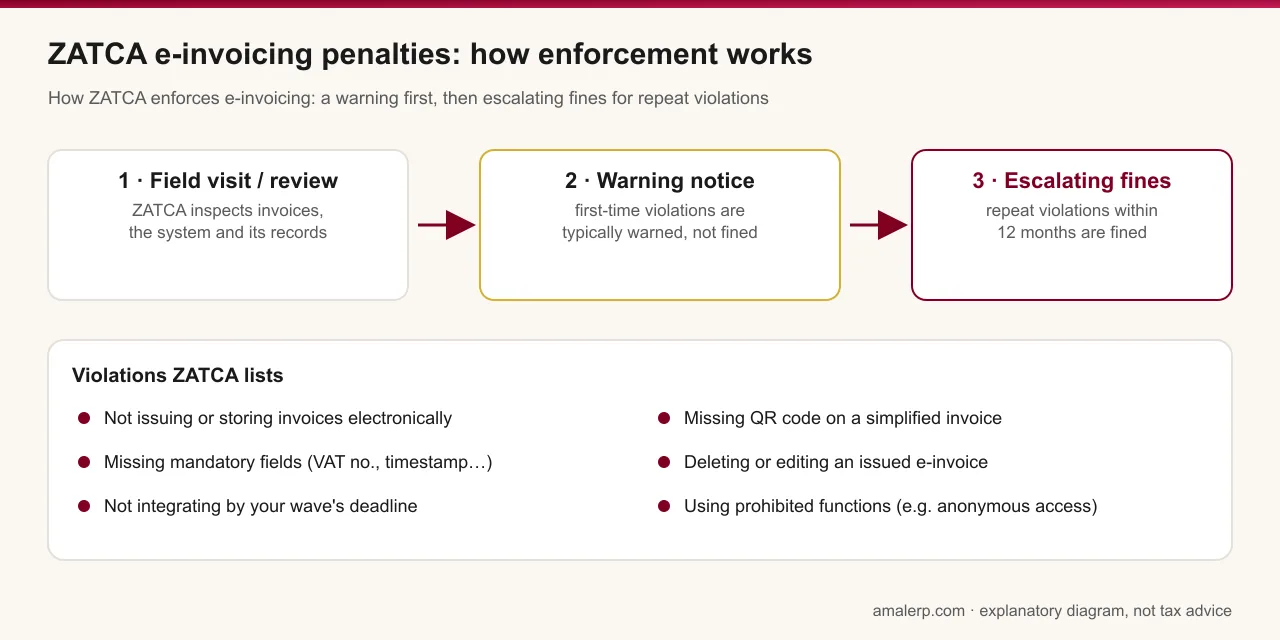
ZATCA fines e-invoicing violations on an escalating scale: a first violation found in a field inspection normally draws a warning and a correction period, and repeat violations within twelve months are fined at rising amounts that reach SAR 40,000 to SAR 50,000 depending on the violation. The violations ZATCA has published are not issuing or storing invoices electronically, deleting or amending an issued invoice, missing QR codes or mandatory fields, not notifying ZATCA of a system malfunction, using prohibited functions, and — since Phase 2 — not integrating with the Fatoora platform by your wave deadline.
That summary hides real disagreement between sources on the exact ladder, so this article separates what ZATCA published itself from what advisers have transcribed, and says plainly where we could not verify a figure.
What are the e-invoicing violations ZATCA lists?
ZATCA announced the violations and starting fines in a press release on 16 November 2021, a few weeks before Phase 1 came into force. Deloitte's summary of the same announcement gives the upper limits. The table below combines the two.
| Violation | Starting point (ZATCA, Nov 2021) | Upper limit (as summarised by Deloitte) |
|---|---|---|
| Not issuing or storing e-invoices and notes electronically | SAR 5,000 | SAR 50,000 |
| Deleting or amending an e-invoice after it was issued | SAR 10,000 | SAR 50,000 |
| Missing QR code on a simplified tax invoice | Warning | SAR 50,000 |
| Missing buyer VAT number on a standard tax invoice | Warning | SAR 50,000 |
| Failing to notify ZATCA of a malfunction that stops e-invoicing | Warning | SAR 50,000 |
ZATCA's wording in that release was that all fines are applied according to the type of violation and the number of repetitions — which is the principle every later schedule follows.
How does the warning-first rule work?
On 30 January 2022 ZATCA revised its approach to VAT and e-invoicing field-control violations to make enforcement educational first. As reported by Sovos at the time: the first violation found in an inspection is met with a warning and a three-month period to correct it; if the same violation is found again, fines of SAR 1,000, then SAR 5,000, then SAR 10,000, then SAR 40,000 apply to successive repeats; and if twelve months pass without a repeat, the count resets and the next occurrence starts again with a warning.
In practice this means a business that fixes a problem after its first inspection pays nothing. The fines are aimed at businesses that ignore a warning.
What is the current fine ladder?
ZATCA's Simplified Guideline for the Classification of General VAT Violations (second edition, May 2024) restated the ladders by violation group. We were not able to retrieve the guideline PDF itself from ZATCA's site when this article was written, so the figures below come from two independent transcriptions by Saudi vendors (Jaicome and Fatorli) that agree with each other. Treat them as reliable but second-hand.
| Violation group | First occurrence | Repeats (in order) | Repeat window |
|---|---|---|---|
| Not integrating with the Fatoora platform by your wave deadline | Warning + correction period | SAR 10,000 → 15,000 → 20,000 → 30,000 → 40,000 → 50,000 | 30 days between checks |
| Not issuing or storing e-invoices; deleting or editing issued invoices; using a prohibited function | Warning | SAR 5,000 → 10,000 → 15,000 → 20,000 → 30,000 → 40,000 | — |
| Missing QR code; missing mandatory fields; not sharing the invoice with the customer; not notifying ZATCA of a malfunction | Warning | SAR 1,000 → 5,000 → 10,000 → 20,000 → 30,000 → 40,000 | 60 days between checks |
The same guideline reportedly exempts a business from the malfunction violation where the outage was caused by ZATCA's own systems, which matches the failure-handling rules in ZATCA's Detailed Guidelines: keep retrying while Fatoora is down, and report a local outage to ZATCA, carry on trading and submit once it is fixed.
What are the legal ceilings?
The VAT Law sets the outer limits that the ladders sit inside. ZATCA's VAT penalties page lists a maximum of SAR 50,000 for violating any provision of the VAT Law or Regulations, SAR 50,000 for failing to keep tax invoices and records, and SAR 100,000 for a tax invoice issued by a person who is not registered for VAT. Fines for a violation repeated within three years may be doubled. The SAR 100,000 figure that some articles attach to e-invoicing is that unregistered-issuer ceiling, not an e-invoicing fine.
Does the fines-cancellation initiative cover e-invoicing?
ZATCA's initiative cancelling fines and exempting financial penalties has been extended several times: to 31 December 2025, then to 30 June 2026, and on 29 June 2026 for a further six months to 31 December 2026. The November 2025 announcement expressly included fines for violations of VAT field control related to applying the e-invoicing regulations. The June 2026 extension, however, lists exclusions including fines imposed under Article 45 of the VAT Law — the general-violation article that several advisers say e-invoicing fines fall under — as well as tax-evasion fines, fines already paid, and returns due after 30 June 2026.
So the honest answer is: it covered e-invoicing fines through 2025, and whether it still does after 1 July 2026 is unclear from ZATCA's own wording. Ask ZATCA or your adviser rather than a vendor, and do not plan around the amnesty — it never removed the obligation to comply, and a business relying on it still has to integrate.
How do you avoid the fines altogether?
- Know your Phase 2 wave and deadline. Wave 24 (revenue above SAR 375,000) was due by 30 June 2026; Wave 25 (above SAR 187,500 in any year from 2022 to 2025) is due by 1 February 2027. The full table is on our Phase 2 page.
- Issue every invoice, credit note and debit note from a system that locks the document and logs it. Word, Excel and receipt books have failed Phase 1 since December 2021.
- Put the QR code on every simplified invoice and the buyer's VAT number on every standard invoice — the two 'warning first' violations that inspectors check first.
- Never delete or edit an issued invoice. Issue a credit or debit note that references it.
- Keep the archive exportable and producible to ZATCA on request.
- If your system fails, notify ZATCA, keep trading, and submit the backlog once it is fixed — that is the documented path, and it is what the malfunction rule expects.
Sources used for this article
- ZATCA press release, 16 November 2021: 'E-invoicing violations and fines' (starting amounts by violation).
- Deloitte Middle East tax alert, 19 November 2021: ZATCA announces violations and penalties in relation to e-invoicing (upper limits).
- Sovos, February 2022: ZATCA announces revised penalties for non-compliance with VAT and e-invoicing rules (warning-first ladder of 1,000 / 5,000 / 10,000 / 40,000).
- ZATCA Simplified Guideline for the Classification of General VAT Violations, 2nd edition, May 2024 — as transcribed by Jaicome and Fatorli (current ladders). Not retrieved from ZATCA directly.
- ZATCA VAT penalties page (statutory ceilings) and ZATCA announcements of the fines-cancellation initiative dated November 2025 and 29 June 2026.
This article is general information, not tax advice. Fine amounts and the amnesty terms change; confirm the current position on zatca.gov.sa before relying on any figure here.