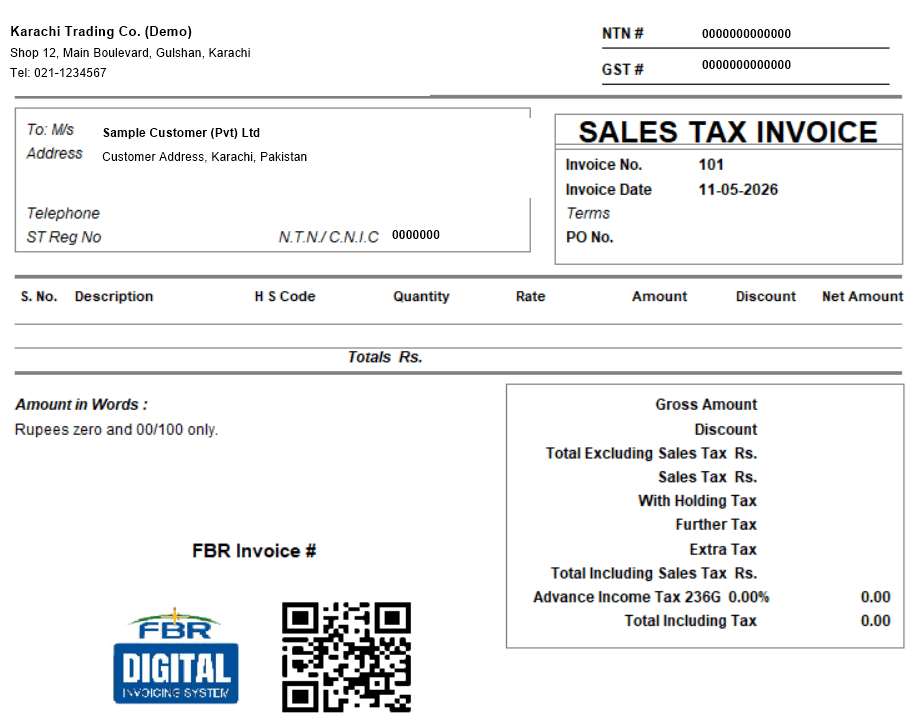
An FBR digital invoice is a normal sales tax invoice reported to FBR electronically at the moment it's issued. Your software sends the invoice to FBR as structured data (JSON), FBR validates it and returns a unique invoice number, and the printed invoice must show that number and an FBR QR code on top of the standard sales tax fields. Here's the full format in plain language — what gets printed, what's inside the JSON, and what the QR code and IRN actually are.
What is the FBR digital invoice format?
The format has two halves. The data half is a JSON payload defined by PRAL's Digital Invoicing API specification (currently v1.12): seller and buyer details, line items with HS codes, and tax breakdowns. The print half is what your customer sees: a sales tax invoice carrying the FBR invoice number, the FBR QR code and a digital signature, alongside the fields every sales tax invoice already needs. Miss either half and the invoice isn't compliant.
What must be printed on an FBR digital invoice?
| Element | What it shows |
|---|---|
| Supplier identity | Your business name, address, NTN and STRN (GST number). |
| Buyer details | Name and address, plus their registration number — or NTN/CNIC where required. |
| Invoice number & date | Your own serial invoice number and the date of issue. |
| Line items | Description, HS code, quantity, rate, amount, discount and net amount per item. |
| Tax summary | Total excluding sales tax, sales tax, any withholding / further / extra tax that applies, and the total including tax. |
| FBR invoice number | The unique number FBR returns when it validates the invoice. |
| FBR QR code | Printed on the invoice so anyone can verify it against FBR's system. |
The image above is a real print layout: the FBR Digital Invoicing logo, the QR code and the FBR Invoice # sit alongside the familiar sales tax fields — it's still recognisably the same invoice your customers have always received.
What is the FBR invoice number (IRN)?
When FBR validates an invoice, it returns a unique 22-digit invoice number — often called the IRN (invoice reference number). It arrives in the API response within moments and must appear on the printed invoice. An invoice without it is not a valid digital invoice: your buyer's input tax claim hangs off that number, and anyone can check it against FBR's records.
What are the QR code requirements?
Every validated digital invoice carries an FBR QR code, generated once FBR accepts the invoice. Scanning it lets a customer — or a tax officer — verify the invoice against FBR's system. Print it clearly on invoices and POS receipts; for businesses notified under SRO 288(I)/2026, the rules additionally specify a QR code of at least 7×7 mm.
What does the invoice JSON include?
Under the hood, your software submits each invoice to FBR as JSON conforming to PRAL's technical specification. The field names are what trip people up, so here are the important ones in plain language:
| Field | What it means |
|---|---|
| Seller & buyer identification | NTN/CNIC, name and address of both parties. |
| hsCode | The HS (Harmonized System) code for each line item. |
| saleType | The category of the sale — it tells FBR which tax treatment applies to the line. |
| rate / sales tax | The sales tax rate and tax amount for each item. |
| extraTax / furtherTax | Additional taxes charged in specific cases — e.g. further tax on supplies to unregistered buyers. |
| sroScheduleNo | The SRO or schedule number quoted when a line claims a reduced rate or exemption. |
| fedPayable | Federal excise duty payable, where it applies. |
| invoiceNumber (response) | The unique 22-digit number FBR returns when the invoice passes validation. |
You never hand-craft this JSON if your software builds it for you — but before going live, FBR's sandbox requires you to pass test scenarios that exercise exactly these fields, which is where most do-it-yourself integrations get stuck.
Can a digital invoice be edited or cancelled?
Only within a window: an e-invoice can be corrected within 72 hours through FBR, and after that you need Commissioner approval. So the format isn't just about printing the right things — it's about getting them right the first time.
What if your invoices don't follow the format?
Invoices issued outside the digital invoicing system are legally invalid — your buyer loses the input tax adjustment on them. Penalties for failing to integrate start at Rs 500,000 for a first default and escalate to Rs 3 million for repeat offenders, and digital invoices must be archived for six years. Our FBR deadline and penalties guide covers the enforcement picture in detail.
How AmalERP handles the format for you
AmalERP connects to FBR through PRAL with direct API access: it builds the JSON, passes the sandbox scenarios, submits every sale in real time and prints the returned FBR invoice number and QR code on the invoice automatically — the exact layout shown above. FBR & SRB tax compliance is a Rs 1,000/month module on top of the Basic plan, so a business gets fully compliant invoicing from Rs 3,500/month all-in.