Updated August 2026. FBR digital invoicing is now mandatory for active sales taxpayers — the phased deadlines have run their course, FBR expected all active filers adopted by 31 July 2026, and that date has passed. If you're registered for sales tax and still issuing manual invoices, you are in the enforcement window, and the cost of waiting has gone up sharply under the Finance Act 2026. Here's the plain version of where things stand.
Who has to comply?
The mandate has been rolling out in phases and is being extended to active sales-tax-registered businesses. If you issue sales-tax invoices, assume it applies to you and confirm your exact date - deadlines have shifted through successive SROs, so check FBR's latest notification or ask your tax advisor.
What the deadline actually means
After the cutover, a compliant invoice is a digital one: submitted to FBR in real time and returned with a unique Invoice Reference Number (IRN), an FBR QR code and a digital signature. Purely manual sales-tax invoices stop being acceptable. In practice, your accounting or POS software has to connect to FBR through a licensed integrator.
The penalties for missing it
Non-compliance isn't cheap. Under the Sales Tax Act, failing to integrate carries a fine of Rs 500,000 for a first default, escalating through Rs 1 million and Rs 2 million to Rs 3 million for repeat offenders — and invoices issued outside the system are legally invalid, so your buyers lose their input-tax claims on them. FBR has also expanded its audit capacity with hundreds of new auditors, and enforcement notices have been going out since late 2025.
What changed under the Finance Act 2026
- FBR can now suspend or de-register the sales tax registration of businesses that fail to integrate — and blacklist repeat non-compliers.
- Importers not integrated with digital invoicing risk losing green-channel customs clearance, in force since 1 July 2026.
- Issuers of fake or simulated invoices face penalties up to the invoice value and a public register of offenders.
In short: the risk is no longer just a fine. Non-integration can now interrupt your ability to trade — clear imports, issue valid invoices, and keep your registration active.
The good news: a 10% tax credit
It's not all stick. Budget 2026-27 introduced a tax credit worth 10% of your investment in FBR-integration software, so getting compliant now is partly rewarded rather than just a cost. We cover that in our guide to the 10% FBR software tax credit.
How to get ready - fast
- Confirm you're in scope and your exact deadline.
- Make sure your invoicing/POS software can produce real-time FBR e-invoices (IRN, QR, digital signature).
- Register and pass FBR's sandbox testing before going live.
- Don't leave it to the last week - testing and integration take time.
Our step-by-step FBR e-invoicing readiness checklist walks through the whole process.
How AmalERP helps
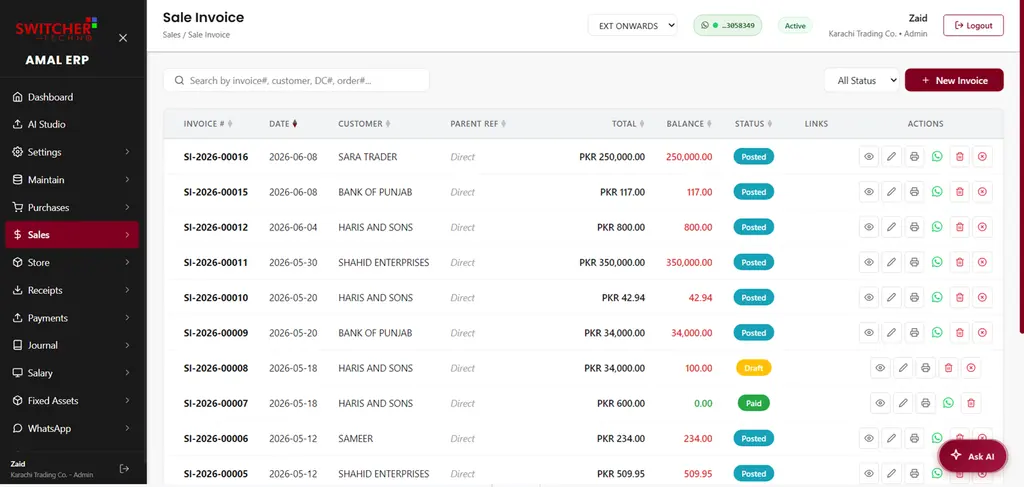
AmalERP connects to FBR's digital invoicing system through PRAL with direct API access, so real-time e-invoices with IRN, QR code and digital signature are built in - and we handle the sandbox-to-production setup for you. If the deadline is looming, talk to our team and get compliant without the panic.
This article is general information, not tax advice. Confirm your deadline and obligations with FBR's latest notification or your tax advisor.