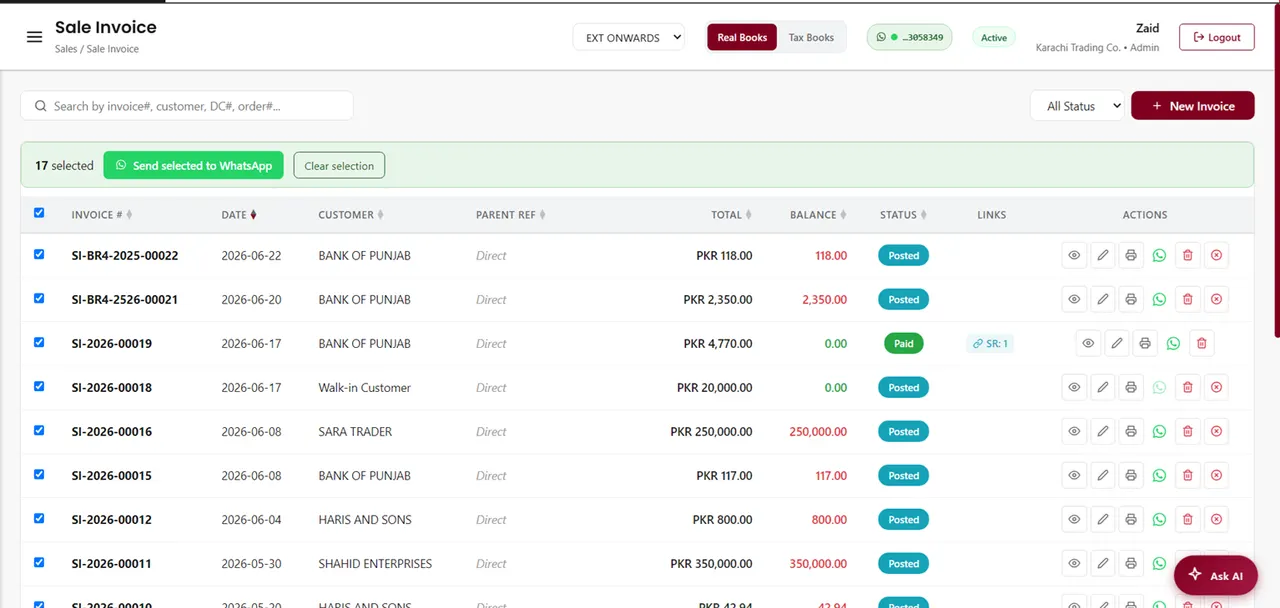
The best FBR digital invoicing software for most Pakistani businesses in 2026 is the accounting or POS system you already run, with FBR compliance built in — so invoices are transmitted to FBR automatically as you issue them, rather than typed twice. If you have no such system, FBR's own PRAL portal lets you issue compliant invoices for free (manually), and dedicated e-invoicing tools sit in between. This guide explains how FBR digital invoicing actually works, then compares your real options. Full disclosure: AmalERP is our product, and we've kept its entry honest. Details were checked in July 2026 — confirm current rules with FBR or your tax advisor.
How FBR digital invoicing actually works
Under SRO 1852(I)/2025, a compliant invoice must be generated electronically and transmitted to FBR in real time through PRAL (FBR's technology arm), which validates it and returns a unique FBR invoice number (an IRN, around 22 characters) plus a QR code that must appear on the printed invoice. You can connect to FBR in one of two ways: directly with PRAL, or through one of FBR's officially licensed integrators. As of 2026 there are eight licensed integrators — Haball, WebDNAworks, EY Ford Rhodes, PRAL, OpenPort Pakistan, TMR Consulting, NatureTech and Dynamic Resources — and a taxpayer may now use more than one.
The important distinction for buyers: a "licensed integrator" is the formal channel to FBR, while the software you actually work in day to day (your ERP, accounting or POS system) is what generates the invoice and sends it through that channel. Most SMEs never deal with an integrator directly — they buy software that already handles the connection. So the practical question is simply: does my software produce a real FBR invoice number and QR code in real time?
Your three routes to compliance
| Route | Cost | Best for | Trade-off |
|---|---|---|---|
| FBR's PRAL portal (free) | Rs 0 | Very small taxpayers, low invoice volume | Manual entry, no accounting behind it |
| FBR-ready ERP / accounting / POS software | ~Rs 2,000–7,000/mo (FBR often a small add-on) | Most SMEs — invoices flow from your books automatically | A monthly subscription |
| Dedicated e-invoicing tool / integrator service | Free up to ~Rs 3,500–30,000/mo by volume (+ setup) | High-volume or businesses keeping legacy accounting | A separate system bolted onto your books |
Route 1 — FBR's free PRAL portal
FBR, through PRAL, offers a free digital-invoicing portal. It is a legitimate, zero-software-cost way to issue compliant invoices with an FBR number and QR code, and for a very small taxpayer with a handful of invoices a month it can be enough. The catch is that it is manual data entry with no accounting, inventory or reporting behind it — every invoice is retyped — so it does not scale, and it does not give you books. Treat it as the compliance floor, not a business system.
Route 2 — software with FBR built in (best for most SMEs)
For most businesses the practical answer is an ERP, accounting or POS system that already speaks FBR, so a normal sale becomes a compliant e-invoice without extra steps. The main rupee-priced options:
| Software | Type | Entry price (Jul 2026) | FBR status |
|---|---|---|---|
| AmalERP | Cloud ERP + accounting + POS | Rs 2,500/mo + Rs 1,000/mo tax module | Built in via PRAL; e.FBR for POS; SRB |
| Moneypex | Accounting + POS | Rs 2,000/mo (+Rs 1,000 FBR add-on) | Built in, auto-transmit with QR; PRA/SRB |
| SadaHisab | ERP-based POS | Rs 1,800/mo (+setup) | Built in, bundled free; PRAL/IRIS |
| CISePOS | Retail POS + accounts | Rs 2,500/mo (+~Rs 1,000 tax add-on) | Add-on: FBR, SRB, PRA, KPRA |
| Hisaab.pk | Accounting/ERP + POS | Contact sales | Vendor claims native FBR API |
| SplendidAccounts | Accounting + inventory + POS | Contact sales | Via FBR IRIS / PRAL |
| Candela / Nimbus RMS | Retail POS | Contact sales | Built in (add-on cost); IRIS/PRAL |
The advantage of this route is that compliance is a by-product of running your business normally — the invoice you were going to raise anyway is the one that goes to FBR. For a sales-tax-registered SME that also needs books, a POS or inventory, this is almost always the right choice, and it usually costs a few thousand rupees a month all in.
A note on our own entry: AmalERP connects to FBR in real time through PRAL for digital invoicing and to e.FBR for POS retailers, with SRB for Sindh. AmalERP is not itself one of FBR's eight licensed integrators — it generates FBR-numbered invoices by connecting through the PRAL/licensed channel — and its FBR/SRB tax module is a Rs 1,000/month add-on on the Rs 2,500/month base, not bundled. We spell that out because the whole point of choosing FBR software is knowing exactly what it does.
Route 3 — dedicated e-invoicing tools and integrator services
If you want to keep your existing accounting system and simply add compliance, dedicated e-invoicing tools and integrator services connect your invoices to FBR for a fee — typically ranging from free at low volume up to roughly Rs 3,500–30,000 a month depending on invoice count, sometimes with a one-time setup charge. This suits high-volume businesses or those with legacy or international accounting they do not want to replace. The downside is that you now run two systems — your books and a separate compliance layer — and must keep them in step.
How to choose
- Very low invoice volume and no need for books? Start with FBR's free PRAL portal.
- A registered SME that also needs accounting, POS or inventory? Choose FBR-ready software — compliance comes free with running your business, at a few thousand rupees a month.
- Happy with your current accounting and just need compliance bolted on? A dedicated e-invoicing tool or integrator service is the lighter change.
- Whatever you pick, confirm it produces a real FBR invoice number (IRN) and QR code in real time — ask for a live example — and check whether you also need provincial coverage (SRB, PRA, KPRA).
- Ask your tax advisor about the 10% tax credit on FBR-integration software under Budget 2026-27; it reduces your net cost.
Details were researched in July 2026 from vendor sites and FBR sources; several vendors do not publish pricing and rules change — confirm directly. This is general information, not tax advice.