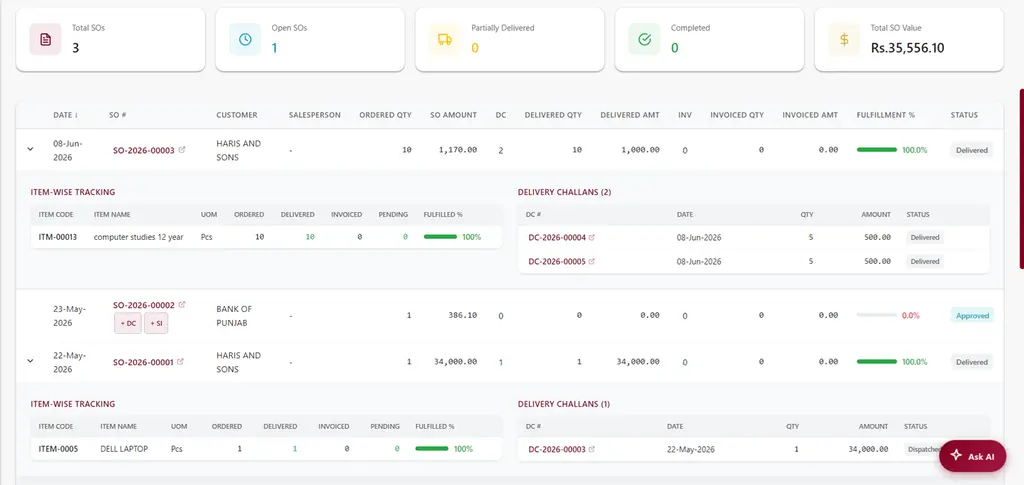
"Order-to-cash" is the full journey from a customer's first quote to the moment their payment lands in your account. When those steps live in separate tools — a quote in Excel, an order on WhatsApp, an invoice in another app — things slip: orders go undelivered, deliveries go un-invoiced, and invoices go unpaid without anyone noticing. Running the whole cycle in one ERP closes those gaps.
What is the order-to-cash cycle?
It's the chain of documents every sale passes through: Quotation → Sale Order → Delivery Challan → Sale Invoice → Receipt/Payment. Each step should flow into the next, carrying the same items, prices and customer — no re-typing.
Where it breaks without one system
- Quotes are sent but never followed up or converted to orders.
- Orders are delivered but the invoice is forgotten.
- Invoices go out but overdue payments aren't chased.
- Nobody can see, at a glance, what's been ordered vs delivered vs billed.
How one connected ERP fixes it
When the chain is linked end to end, every document is created from the previous one and the status is always visible:
- Ordered-vs-delivered-vs-invoiced tracking on every order.
- Credit-limit and overdue warnings before you ship more.
- Per-line profit, so you know the margin on each sale.
- Every invoice and receipt posts to your accounts automatically.
The purchase side too (procure-to-pay)
The same logic runs in reverse for buying: Requisition → Purchase Order → GRN (goods received) → Purchase Invoice → Payment, with import landed-cost handled. Both chains feed the same ledger and stock, so your numbers always reconcile.
Why 'linked' matters for cash flow
When every step is connected, you always know exactly what's owed to you and what you owe — and nothing falls through the cracks. That visibility is the difference between chasing your tail and running a tight, predictable cash cycle.
How AmalERP does it
AmalERP runs the full sales and purchase chains, linked end to end, with live ordered/delivered/invoiced tracking, credit control and per-line profit — and every document posts to double-entry accounts and inventory as you go. See it in the features overview, or start a free trial on your own data.