When you buy the same item at different prices over time, which cost do you use when you sell one? That choice — your inventory costing method — quietly changes your reported profit and the value of your stock. The two most common methods are FIFO and weighted average. Here's how each works and which to pick.
FIFO (first in, first out)
FIFO assumes the oldest stock is sold first. So your cost of goods sold uses the earliest prices, and the stock left on hand is valued at the most recent prices. It mirrors how most physical stock actually moves, especially perishable or dated goods.
Weighted average
Weighted average blends every purchase into a single average cost per unit, recalculated each time you buy. Every item sold uses that blended cost. It's simple, smooths out price swings, and suits items that are interchangeable.
A simple example
Say you buy 10 units at Rs 100, then 10 more at Rs 120, and sell 10. Under FIFO, those 10 sold cost Rs 100 each (cost of goods sold = Rs 1,000) and your remaining 10 are valued at Rs 120. Under weighted average, the blended cost is Rs 110, so the 10 sold cost Rs 1,100 and the remaining 10 are valued at Rs 110. Same purchases — different profit and different closing stock value.
How each affects your numbers
- When prices are rising, FIFO gives lower cost of goods sold and higher reported profit (and a higher-valued closing stock).
- Weighted average smooths the effect, so profit doesn't swing as much with price changes.
- Because profit differs, the method can affect your tax position too.
What about LIFO and specific identification?
Two other methods come up in searches. LIFO (last in, first out) is not permitted under IAS 2, the inventory accounting standard Pakistani financial reporting follows — so in practice it is not an option here. Specific identification tracks the exact cost of each individual item; it is the most precise method but only practical for high-value, uniquely identifiable goods like vehicles, machinery or large marble slabs.
FIFO vs weighted average at a glance
| FIFO | Weighted average | |
|---|---|---|
| Cost of a sale | Oldest purchase price first | Blended average of all purchases |
| When prices rise | Higher profit, higher closing stock value | Smoothed profit, moderate stock value |
| Best for | Perishable or dated stock | Bulk, interchangeable items |
| Effort | Must track purchase layers | One average, recalculated on each purchase |
| Tax effect | Profit (and tax) swings with prices | More stable taxable profit |
Which should you use?
- FIFO suits perishable or dated stock, and when you want stock valued close to current cost.
- Weighted average suits bulk, interchangeable items, and businesses that want simplicity and stable margins — for most Pakistani SMEs it is the practical default.
- Specific identification only for big, individually-tracked items.
- Whatever you choose, stay consistent — switching methods often distorts comparisons.
- Let your software calculate it automatically — manual costing in Excel is where errors creep in.
How AmalERP handles it
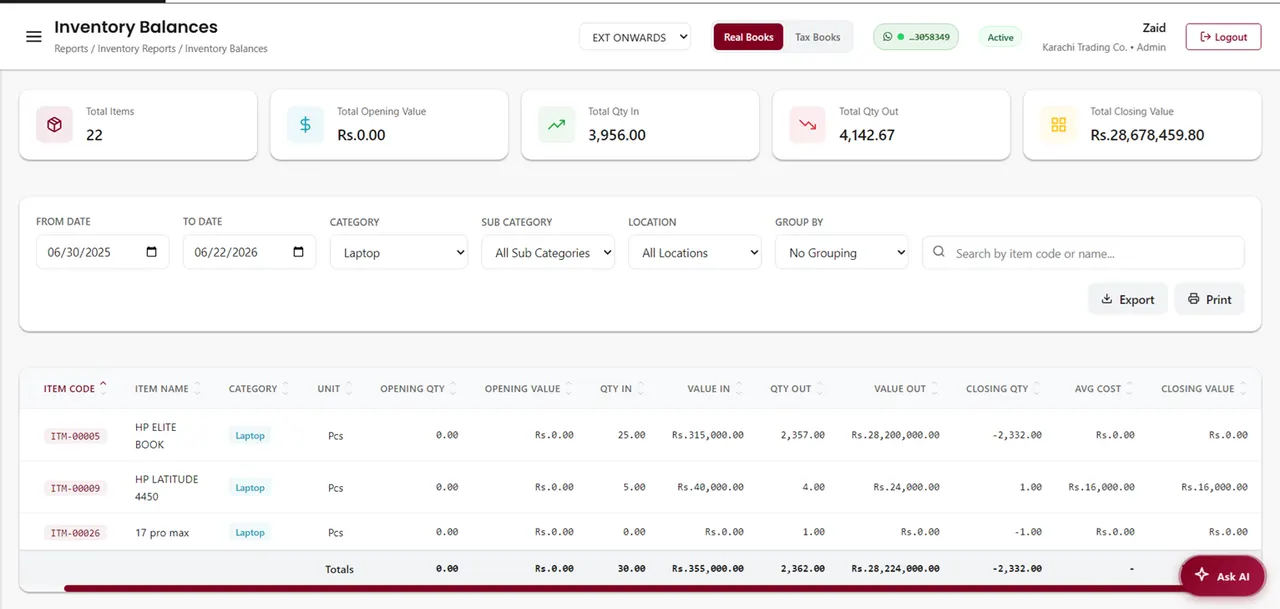
AmalERP's inventory software values stock using weighted-average costing, recalculated automatically on every purchase — so your stock value and profit stay accurate in real time without any manual working. You can see it live in the inventory balances report, alongside quantities in, out and on hand.