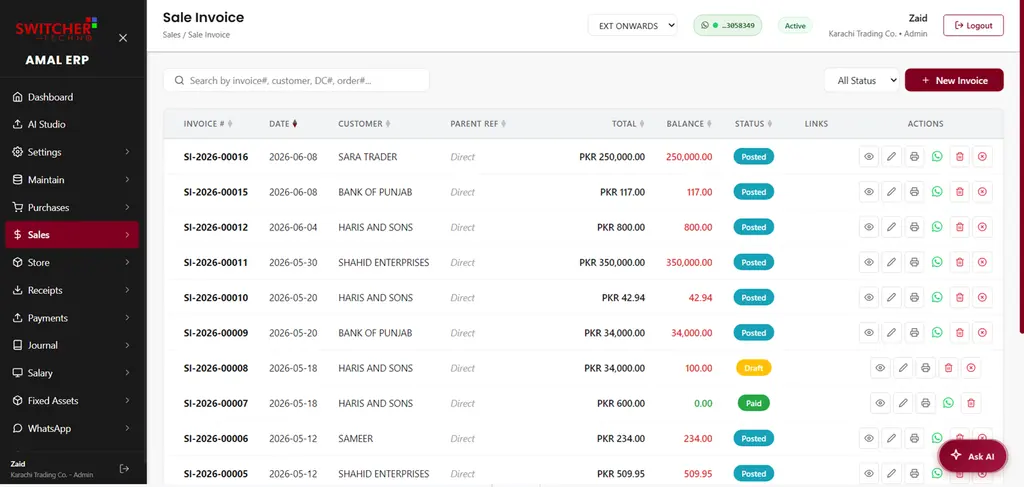
FBR digital invoicing — also called e-invoicing — means sending each sales tax invoice to the Federal Board of Revenue's system in real time, having it validated, and issuing the customer a verifiable invoice with a QR code. It is one of the biggest changes to how businesses in Pakistan bill their customers, and it is being rolled out in phases. Here's what it means in plain English.
What is FBR digital invoicing?
Instead of printing an invoice purely from your own system, your software submits the invoice electronically to FBR in a structured format (JSON). FBR validates it and returns a unique invoice number and a QR code. You then issue the customer an invoice that carries that QR code, which anyone can verify with FBR. This is what tax authorities call a 'continuous transaction control' model — every taxable sale is reported as it happens.
Who has to comply, and when?
The mandate is being introduced in stages. It started with the largest taxpayers and is expanding outward over time:
- Public sector and large enterprises.
- Importers.
- Businesses with very high annual turnover (the first wave covered companies above roughly Rs 1 billion in revenue).
- Later phases bring in more registered sectors and smaller businesses.
The exact dates moved more than once through successive SROs (for example SRO 1852(I)/2025 and SRO 288(I)/2026, which extended requirements to notified service businesses such as restaurants, clinics and couriers). As of August 2026 the rollout has effectively completed: FBR expected all active sales tax filers on digital invoicing by 31 July 2026. If you are registered and not yet integrated, assume you are in scope now and confirm your position with FBR or your tax advisor.
How a digital invoice actually works
- You create the invoice in your accounting or POS software as usual.
- The software sends it to FBR — directly or through a licensed integrator (or PRAL) — in structured JSON.
- FBR validates it and returns a unique invoice number and a QR code.
- You give the customer the invoice showing that QR code.
- The invoice is stored and archived securely (records must be kept for six years).
What a compliant invoice must show
- Your NTN and STRN.
- The buyer's details.
- The unique FBR invoice number and the verification QR code.
- Line items with quantity, unit price, tax rate and sales tax amount.
The 72-hour rule
An electronic invoice can usually be amended, cancelled or deleted within 72 hours through the FBR system. After that window, changes need approval from the Commissioner Inland Revenue. In practice this means getting the invoice right at the point of entry matters more than ever — accurate tax rates, codes and customer details up front save you a lot of trouble later.
Penalties for non-compliance
Penalties under the Sales Tax Act are significant — Rs 500,000 for a first default, escalating to Rs 3 million for repeated violations — and invoices issued outside the system are legally invalid, putting your buyers' input tax claims at risk. The Finance Act 2026 raised the stakes further: FBR can now suspend or de-register non-integrated businesses, blacklist repeat non-compliers, and remove non-integrated importers from green-channel customs clearance. The cost of getting ready is far smaller than the cost of being caught out — see our deadline and penalties guide for the full enforcement picture.
How to get ready
- Make sure your accounting or POS software produces proper, structured sales tax invoices.
- Keep your NTN, STRN, tax rates and item codes clean and correct.
- Choose software built with FBR and SRB compliance in mind, not bolted on afterwards.
- Plan your integration through a licensed integrator or PRAL well before your deadline.
- Don't wait for the last date — testing and registration take time.
Where AmalERP fits
AmalERP is built with FBR and SRB compliance in mind — real double-entry accounting, GST (sales tax), withholding tax, NTN/STRN, structured tax invoices and the reports you need at filing time. If your business falls under the digital invoicing mandate, talk to our team about getting FBR-ready the right way.